Tuesday, January 12, 2010

The A Team


Pffff…a loud noise startles me as I am preparing to lower an instrument into the water that measures conductivity, temperature and depth. About thirty feet to my left I see a smooth black surface with a large blowhole disappearing beneath the waves, and then a humped back rises behind.

A humpback whale visited me and my partner Amanda yesterday as we collected water samples in our zodiac boat. It circled and showed itself twice more in the next minute. It was very special to be near such a large animal, but it was also disconcerting because it was probably twice the length of our boat! At one point it looked as though it was coming straight toward us (although it was actually moving directly away) and my mind flashed to the story of the whaling ship Essex that was rammed and sunk by a sperm whale in the South Pacific. Of course that was very different, but it didn’t seem so far fetched when we were out in our little inflatable boat. It was certainly a wildlife encounter that I will never forget.

The A Team, my partner Amanda and I, collects water samples twice weekly from two different sites, at five different depths: 50m, 25m, 10m, 5m and the surface. “Station E” is about two miles from shore and “Station B” is just off of a point near Palmer Station. When we go boating, we wear so much clothing that Amanda calls herself the Michelin man and it certainly seems so. Between the long underwear, fleece pants, fleece jacket, possibly a vest, rubber fisherman’s bibs, hat, balaclava, heavy Sorrel boots and our bulky orange “float coats,” the world beyond our bodies begins to seem far away. We also have a complicated glove system: there are leather work gloves that are good for dexterity but not waterproof, there are the lined rubber gloves that do not allow for a huge range of motion, and there are thin wool liner gloves, best for fine motor tasks but not good for cold protection. Then some of our fieldwork requires that we wear latex gloves, but latex gloves alone would probably lead to frostbite so we wear thin polypropylene or wool liner gloves underneath XL latex gloves. Quite a bit to think about!

For safety purposes, we also bring a drybag filled with extra clothing, and food in case we are stranded on an island due to bad weather. In addition there are marked emergency caches on many of the islands within the boating limits, containing food, tents and stoves. I am glad that the weather has been good so far!!

But back to work: once we arrive at our sample collection station, we attach cylinders with open ends to a cable that we lower into the water with a winch, and then we can close the ends of all of the bottles simultaneously. Once we pull the bottles back up, we take water samples for dissolved organic carbon and for ammonium concentrations. We take the rest of the water back to the lab and take more of it to count the density of bacterial cells using a flow cytometer.

In addition, we take small amounts of seawater and add a radioactively tagged amino acid to some and a radioactively tagged nucleotide to others. The significance of the amino acid (leucine) is that the bacteria use it to make proteins, so the rate at which they uptake it tells us about how fast they are growing. The bacteria use the nucleotide (thyamine) to make DNA, so their rate of thyamine uptake tells us about how fast they are dividing. We allow the bacteria in the water to take up the leucine for a specified amount of time and then we kill them, likewise with the thyamine. We remove all the seawater leaving just the bacterial cells. When we measure the radioactivity in the bacteria we can calculate how fast they took up the tagged leucine and thyamine that we gave them.


The significance of this is that from the rates of protein and DNA synthesis, one can model the rate of overall carbon uptake. Since bacterial are the recyclers of the ocean (and the land), they are a crucial link in the carbon cycle. If their abundance changes or if the timing of their annual bloom shifts, there could be major implications for carbon cycling and storage in the ocean. The West Antarctic Peninsula is a great place to study the effects of climate change on microbial ecology because this marine ecosystem is one of the most productive on the planet, AND temperatures are warming faster here than anywhere else on earth. I have arrived at ground zero for climate change and I’m holding a pipette!!

Monday, January 11, 2010

The real last frontier


I have heard of Alaska referred to as the last frontier, and although I have never been to Alaska, I would say Antarctica is the last frontier on earth. I notice it right here at Palmer station, in the mentality of the people around me. There is a frontier sense of hospitality: when a ship comes by our base, we will invite them to have dinner with us, unless it’s a cruise ship with more than 200 passengers, in which case we will give a presentation onboard the ship about our research. The visitors usually bring an appetizer to share, and then invite us onto their ship or yacht for the evening. There are so few people around here that them showing up in the harbor is reason enough to socialize. Similarly, we all rely on each other for help if things go badly; our search and rescue team has rescued extreme skiers in the mountains near the station.

Safety is a huge concern on the station because help is several days away. As I wrote in a previous post, it seems that half of station employees are on the fire brigade, and there are frequent drills. Every several years, an Antarctic base goes up in flames and it could be us next time. If there were to be a fire, we would have to fight it ourselves, and survive until help could arrive. This is the reason for two main buildings: if one burns down we can shelter in the other one. There is also danger associated with the scientific research and chemicals at the station. I have never seen so many spill kits in a lab! Likewise with health and hygiene: there is a sink directly in front of the food table in the kitchen, and everyone must wash their hands every time they get food, even if it’s for seconds. In addition, the bathroom nearest the kitchen is for No. 1 only, to reduce possible contamination by fecal matter.

The sense of being on a frontier is even more strongly evident when you think about the landscape beyond our station. A google image search for maps of this area turns up few results, and none on a fine scale. The nautical chart seems to be the best respresentation, and it doen’t map more than a few miles inland. But who would need it? No one goes there. And some of the islands on the charts have little notes saying that they are probably not placed in the correct location. At the southern end of her scientific cruise, the Gould will attempt to circumnavigate an island that emerged last year when the Wilkins ice shelf collapsed. The captain is concerned because the waters that have opened up are uncharted. Uncharted! Who can say they have literally been to uncharted waters anymore? Actually I suppose it will become more common as the ice shelves continue to collapse.

Another important aspect of a frontier to me is a lack of state presence. True, the settlement of a frontier is almost always a political act, and it is here to some extent as well (the Chilean and Argentinian bases pointedly have children and schools). But the governing Antarctic Treaty, an agreement between 45 countries to protect Antarctica, remains an abstract concept to me. More than anything Antarctica is a place where anyone is free to come, with no borders and few rules beyond not disturbing the wildlife.

Sunday, January 10, 2010

What am I doing here??


So what am I doing in Antarctica? I have been caught up in describing this fascinating place and haven’t explained why I am here! I am doing field and lab work as part of Long Term Ecological Research (LTER) at Palmer Station. The LTER network was founded by the National Science Foundation in 1980 and consists of 26 sites throughout the United States, including 2 sites in Antarctica. LTER research began at Palmer in 1990 and continues today, mostly centering on an annual 6-week research cruise along the West Antarctic Peninsula. I came down to Palmer on that cruise, although myself and another lab volunteer, Amanda are staying at the station to collect water samples while the ship continues southward.

The LTER team looks at many areas of ecosystem dynamics, from the microbial level (my research) to phytoplankton, zooplankton and krill, to larger animals like fish, seals and penguins. Physical oceanography is also documented. I think this is what science should be: people with different areas of expertise working together to try to understand a complex and changing system. There is a group from Rutgers University looking at phytoplankton and deploying rocket-shaped gliders that track oceanographic characteristics like temperature, salinity and chlorophyll levels. A group from the Virginia Institute of Marine Science at the College of William and Mary studies zooplankton, of which krill is the keystone species here in the Antarctic. A group from MSU Bozeman studies penguin diet, foraging behavior and response to human presence. A student from Woods Hole Oceanographic Institution/MIT is collecting data on particulate flux through the water column, and my group from Woods Hole Marine Biological Laboratory (MBL) is collecting data on bacterial abundance and growth rate, as well as chemical and nutrient cycling in the ocean such as dissolved carbon, and ammonium and other nitrogen species. Although there are specific aspects of the ecosystem that we are particularly interested in, LTER is a holistic study of an rather than a specific research question.

More often scientists research a specific question because it’s what they can get funding for, but that imposes the arbitrary framework of funding on the natural world that we are studying. In reality, what you find out from research is often not what you set out to investigate. When you write a grant, you are guessing what the most compelling aspect of your research area is and you propose to study it. But how can you know what is most significant before you study it? LTER allows for a more measured exploration of a study area, to really understand relationships between the elements and species in an ecosystem. Each season of fieldwork becomes one data point, in a long timeseries. My research doesn’t have a specific punchline for this year; I am collecting the 7th year of microbial ecology data, and it may take 20 years of data to understand the dynamics of the carbon cycle at the microbial level. So it’s not sexy, but it’s how science should be.

Saturday, January 9, 2010

Welcome to Palmer Station


I am writing this post from the combined lounge and dining room in Palmer Station! Through the big windows I can see the spires of brilliant white icebergs in the harbor, and snowy mountains over the water to the south. This isolated field station is situated on Anvers Island, on a rocky strip of land at the foot of a dome of ice called the Marr Ice Piedmont. I had never heard the term “ice piedmont” before now but it seems to be a small ice cap. This one covers most of the 38-mile long island. The station is only accessible by boat, and in summer is supplied roughly every month by the research and supply vessel that I arrived on.

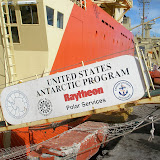
There are 45 people on the station now in the summer, about half of which are scientists and half are science support staff employed by the United States Antarctic Program and Raytheon Polar Services. The scientists come and go through the season but the support staff members stay for 5-9 months. The science here focuses on the ocean and the small islands nearby: collecting plankton and krill, studying insects and birds on the islands, taking water samples.
The station feels like a combination of a small town/summer camp/youth hostel/co-op, but whatever you call it, the sense of community here is strong. There is a fire brigade, which consists of about half of the people on station, which drills frequently, as well as a glacier search and rescue team and a marine search and rescue team. The “store” is a closet filled with toiletries, souvenir t-shirts and duty free alcohol. There is also a bar that people stock themselves with alcohol from the store: if you buy a bottle of wine, you leave it in the bar and you can drink it yourself or share with others and drink some of what they have bought. It’s all on the honor system but it works well.

We have an FM radio frequency that broadcasts NPR from the US. In addition, everyone on station has a communication radio that we use when we’re out on the water but also to contact people when we’re at the station. It’s not unusual to hear over the radio that a seal is visible on an iceberg floating by. We also gather to listen to the band formed by station employees, or to hear tales of their travels during their time off. One night there was a “drive-in movie” projected onto the side of a white shipping container outside, complete with popcorn. Sundays are disc-golf days, played on a course in the “backyard,” the 300 meters of rocky land between the station and the glacier.

Art by employees, scientists and visitors adorns the station: watercolors, oil paintings, metal sculptures. The doors of the sleeping rooms are painted with a beautiful bird, each one different. In the main dining room there is a woodburning stove with a beautiful metal sculpture of a breaching humpback whale. Years ago, someone welded together a roasting spit that can accommodate a whole pig. Oh and the hot tub! Originally a fiberglass fish aquarium, it is now used on most clear evenings and is the spot to go after taking “polar plunge”!

This small society is incredibly organized and efficient. Everyone washes their own dishes, and once a week participates in Galley And Scullery Help: cleaning up the kitchen and dining room after dinner. And this is serious deep cleaning, not just sweeping the floor. On Saturday afternoons everyone picks a task out of a hat, like cleaning bathrooms or washing windows. Then we turn up the music and work! It’s like the co-op where I lived in college except that the tasks actually get done and the place is spotlessly clean.

Tonight we’ll also gather to listen to the lab manager compete on the NPR news quiz show Wait Wait Don’t Tell Me, which was taped several days ago. So my first week at Palmer almost over and the little community here has already enveloped me.

Thursday, January 7, 2010

Land of Ice

When I woke up on the fourth morning of the journey, the fjords and mountains of the Antarctic Peninsula surrounded the ship. This is a new world, a wonderland of ice. Ice covers every non-vertical surface, topping ridges that drop off into cliffs, spilling over, carving new valleys, covering rises and making their summits into icy nipples, ice cones. The ice approaches the water’s edge, splitting into cracks parallel to the shore, each block stepping down further and revealing the pale but brilliant, glowing blue. The closest analogy I can think of is the glowing of coals within drab ash. This white and blue world is alien, inhospitable, inhuman. I understand now what the chief scientist meant on our last day in Punta Arenas when he said “Today is our last day in the real world.”

This place seems like it must have been made up, maybe in a dream. I try to find words to describe it but all I can think of is that words were never meant to describe what I am seeing. Language feels more comfortable describing agriculture, cities, emotions, politics, history, and it never had to describe Antarctica until recently. It seems inappropriate to use words to communicate my feelings. I imagine that an astronaut trying to describe space, or a deep sea diver might have similar frustration. I can take photographs, but again there is a problem that my camera was not designed to capture a white world so it also does a pretty poor job.

You might be thinking, “Well, I’ve seen a mountain and a glacier before. Antarctica just has a lot of them. How is that so surreal?” It is the scale of the icy landscape that is so unbelievable. It goes on and on without any other color than blue. No green, no brown tucked away in a valley. Behind each mountain range are more ice-filled peaks and valleys, a far-off glacier shining white through a break in the clouds.

Another surreal aspect of standing on the deck of the ship that first morning was the menagerie of marine animals all around us. Minke whales were spouting left and right. Seals lounging on icebergs slid off into the water as we approached. Penguins jumped out of the water in groups like dolphins, their small plump bodies a flash of black and white. It was like an illustration of a forest in a picture book, with every animal showing itself.

I still can’t associate myself with the landscape around me, I can’t believe that my body is in the same space as the glaciers covering the land. Now that I am here, I still can’t imagine being here.

Wednesday, January 6, 2010

South

So much for the most treacherous waters on earth! Crossing the Drake Passage was like skipping across a playground. No one on the ship had seen such a smooth crossing, except the captain who said it was in his “top three.” I think he just didn’t want to admit that it was the best. Always leave room for improvement, you know. I was hoping to tell stories about 65 foot waves, or how I was thrown out of my bunk but alas! now I’ll just have to make them up.

Our ship was named after Laurence M. Gould, a geologist and early science administrator. It is 230 feet long accommodates 22 scientists, 8 support staff (machinists, technicians) and about 10 deckhands. Our two days in port were full of preparations – loading containers onto the ship using the boom and securing everything for the crossing. It takes four days to reach Palmer Station, Antarctica from Punta Arenas: one day sailing east through the Strait of Magellan, two days in the open waters known as the Drake Passage and then one day along the fjords and glaciers of the Antarctic peninsula.
Drake Passage


I was surprised at how exciting it felt to pull away from the pier. I was excited about the general idea of leaving Punta Arenas on the ship, but I didn’t realize how intensely the anticipation would solidify at the moment that we cast off the ropes and set sail. Suddenly Antarctica seemed a lot closer. The port crew was standing on the pier, waving at us and whooping as we began our journey.

The ship has five decks in addition to the hold: a level with science labs and the galley, a level with the scientists quarters and the lounge, a level with the crew quarters, another which I’m not sure about, and the bridge on top. The bridge was my favorite place because it has windows looking on three sides, and the engine’s roar is very quiet. The swell was most sensible there, and the slow rocking was relaxing. The pilot explained how he uses GPS and compass bearings to steer the ship, and showed how he marks our hourly position on the nautical chart. There were bird and sea mammal books and binoculars as well. I saw penguins and dolphins in the Strait of Magellan, as well as seabirds: petrels, scua, shearwaters, and my favorite, the albatross.
The galley looks a bit like an old diner, with swiveling stools arranged around three long turquoise tables. Their metal rims to keep plates from sliding off are reminiscent of chrome piping. Another space of note is the lounge, with couches made out of huge lazyboy chairs and a big TV with lots and lots of movies. There is also a sauna and a small exercise room.

We could also go outside on the deck and stand at the bow, feeling the wind and seeing water all around. I have never seen such blue water in the ocean, because here there are so few of the photosynthetic plankton that make seawater green. It’s a deep color but luminous where the sun penetrates it. Maybe what you would call cobalt?

Standing at the bow and looking due south, I imagined all the great explorers who have looked ahead in this direction from the bow of a ship. It is inspiring to think that I am following in their footsteps, although in much greater comfort!

I loved watching the Dark Browed Albatross, which has a gray body and white wings, and a heavy black brow that makes it look very stern. It glides along just above the surface of the water, particularly in the wave troughs. When it turns it lifts one wing tip up while the other wing tip almost touches the water, and it pivots around that point. Its precision and grace are mesmerizing. One albatross flew alongside the ship, gaining on it and I ran forward along the deck, eye to eye with the bird. It was an intense moment that sticks in my mind. When I went back inside the ship, everyone asked me what I had seen because my face was so full of excitement and joy.

I slept in the hold, in a “berthing van,” a small shipping container modified for sleeping quarters, which I shared with 3 other girls. Our bunks were cozy, with curtains and reading lamps. The rocking of the ship is less severe in the hold than anywhere else, which was good for us first-timers. The down side was that we had to go up a flight of stairs for the bathroom and two flights for the shower. Those stairs are very steep, and they seemed steeper in the morning as I stumbled up them. At first I had to hold onto the railings on both sides. All the spaces are pretty small, and it was almost painful to see some of the very tall crewmembers walking around almost grazing their heads on the ceiling. A ship doesn’t seem to be the best place for a tall person.

I settled in into a feeling of being calmly adrift. The almost continuous daylight and my lack of responsibilities on the crossing combined to eliminate my sense of time. In addition, the van was entirely dark if the light wasn’t on so when I woke up I had no idea what time it was. However I was very happy waking up whenever I wanted, reading, going up to the bridge, reading, eating a meal, and repeating. Sometimes I would stop by the blow-up NYT Sunday crossword puzzle pasted in the hallway and try to help out. I can imagine that so much unstructured time could be disorienting, but I loved drifting along.

Standing at the bow and looking due south, I imagined all the great explorers who have looked ahead in this direction from the bow of a ship. It is inspiring to think that I am following in their footsteps, although in much greater comfort!

Our New Year’s celebration was unusual. The first mate sent a prank email about a party in the sauna, but it sounded like a good idea to enough people that we made sure it happened. We dressed up in our “Extreme Cold Weather” gear and had a rockin’ dance party in the ship’s sauna. At midnight, when we were about to faint from overheating, we put on handmade party hats and trooped up to the ship’s bridge where we stood outside and banged pots and pans to ring in the new year at the bottom of the world. The cloud cover made the sky dark except at the horizon, where a thin strip of clear sky glowed pink from the lingering sunset. Even though there is no alcohol allowed on the ship some people felt hungover the next morning because of the dehydration of the sauna!

As we continued south, the energy of the scientists and crew alike seemed to increase. I could feel the excitement of the chief scientist building. Even on his 25th crossing of the Drake, he became more and more animated by the hour. I began to understand the draw of the white continent even before I saw it.

Tuesday, January 5, 2010

Jumping off from Patagonia

My first post from Antarctica! My ship arrived on Sunday at Palmer Station after completing the Drake Passage. I know you want to hear all about Antarctica now that I'm here but before I do that, I want to describe the very beginning of my trip and our preparations in port in Punta Arenas, Chile. So for now it's enough just to say that I am safe and sound on the Frozen Continent.

I could spot Antarctic bound passengers on my flights to Dallas and then Santiago de Chile by their beards and general scruffiness. A tall, thin, taciturn man who reminded me a bit of the man in the painting “American Gothic” turns out to study penguins. Another with long curly hair is more like an overgrown kid – loud, happy-go-lucky and hard drinking. He also happens to be the leader of the group studying zooplankton.

We were in port for two nights and parts of three days. Aside from being fitted out with “Extreme Cold Weather” gear, I was free to explore Punta Arenas. The city is made up of mostly one-story houses with gabled roofs and brightly painted walls and corrugated metal roofs although the buildings bordering the central square are in a grand colonial style. From a hill behind the city you can see a panorama of the colored roofs and the Strait of Magellan. Apparently Punta Arenas was one of the most important ports in South America before the Panama Canal was built; ships from all over the world stopped here on their way through the Strait of Magellan, passing from one ocean to another. Now, Punta Arenas is not a sleepy town even though it has been marginalized by the building of the canal and it is thousands of miles from Santiago, the capital of Chile, and not even connected to rest of country by road. The sidewalks are busy with well-dressed pedestrians, numerous taxis clog the streets, and there are significant public buildings – a post office, city hall, military headquarters.

Rather than the language, I found that the biggest difference between Punta Arenas and the United States was that the days were 20 hours long. The sun rose before 4am, and the sky was light until almost midnight. It was quite strange coming from winter in the United States, when I come home from work in the dark. Almost as much as the length of daylight, I noticed a difference in the quality and the rate of change. It felt like midday from 9am – 5pm, and the fast-changing morning and late afternoon light was missing. This difference is because the sun's trajectory is oblique relative to the horizon line. At the latitude of the United States, the sun rises in a line almost perpendicular to the horizon, so it gets high more quickly, and then sinks more quickly. But at high latitudes like Patagonia and Antarctica (and Alaska in the northern hemisphere), the sun's path is at a low angle to the horizon and it takes a long time to rise and to set (and sometimes it never sets!).


Coming soon: the Drake Passage crossing!